Sahel Realignments: What They Mean for the North
Three years after the coups, the AES has consolidated into a durable neighborhood shift with real consequences for the Maghreb.
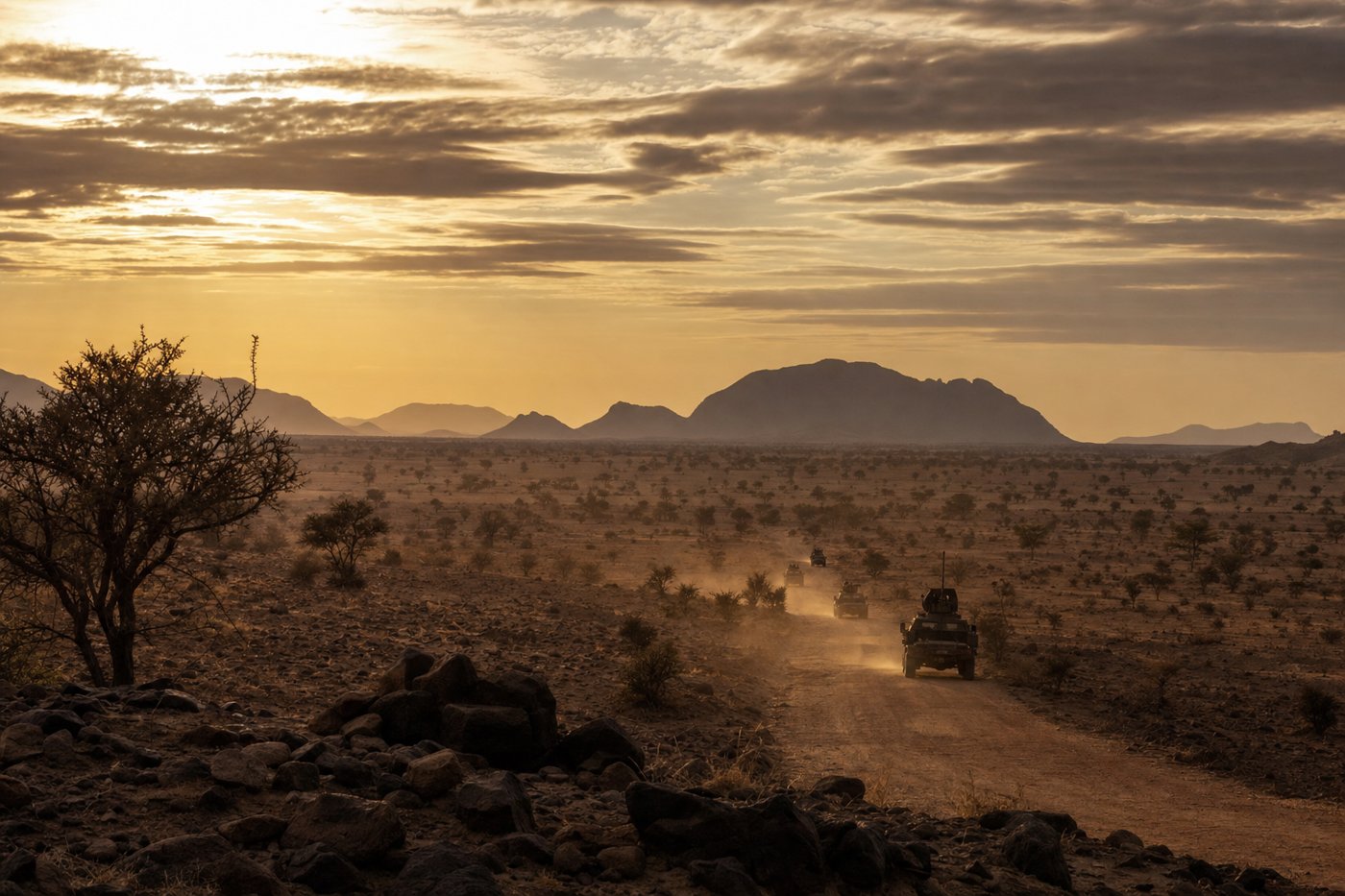
The Sahel is no longer a peripheral file for North African governments. Three years after the coups that brought military juntas to power in Mali, Burkina Faso, and Niger, the region has consolidated into the Alliance of Sahel States (AES) a confederation with its own diplomatic posture, its own defence architecture, and, increasingly, its own external partnerships. For governments in Rabat, Algiers, and Tunis, this is no longer a distant story about francophone West Africa. It is a direct neighborhood shift with implications for migration, trade, informal economies, and the reshaping of great power presence at the Maghreb's southern flank.
A confederation, not a phase
The AES has moved from provisional arrangement to institutional reality. In May 2026, the three member states confirmed joint airstrikes in Mali, signaling a shared operational posture rather than three separate national campaigns (Africanews). In July 2026, Russian Foreign Minister Sergei Lavrov met his AES counterparts in Niamey, where they pledged to deepen military cooperation and welcomed "growing military and military technical cooperation," including assistance from Russia's Africa Corps (Reuters). A Russia and Africa summit is scheduled for October 2026.
The AES is also recovering financial oxygen. Niger secured a $91 million International Monetary Fund financing package in early 2026, part of a broader normalization of relations between AES governments and multilateral institutions after two years of isolation (Stimson Center). This matters. A cash constrained Sahel is a defence problem; a Sahel with restored access to the IMF and World Bank is a different neighbor to plan around.
Russia's role, and its limits
The paramilitary calculus has shifted. Africa Corps replaced Wagner after Prigozhin's failed rebellion in 2023 and first deployed to Niger in April 2024. Russia now accounts for roughly 11% of arms imports to West Africa and the Sahel, behind China at 26% and tied with Türkiye at 11%, according to Carnegie Endowment analysis (Carnegie). Mali alone absorbs 54% of Russian deliveries to the region.
But Russia's Sahel project is not a stabilizing one. Since September 2025, Jama'at Nusrat al Islam wal Muslimin (JNIM) has imposed a selective fuel blockade around Bamako. Around 1,000 Africa Corps combatants have been deployed to secure fuel convoys, and access to fuel in the capital had not fully resumed by early 2026 (Carnegie). In April 2026, an al Qaeda affiliate and a Tuareg led separatist group carried out attacks across Mali and killed the country's defence minister; further attacks on army posts followed on July 4 (Reuters). Insurgency has not been suppressed. It has adapted.
What this means for the North
Three consequences deserve serious planning attention in the Maghreb.
First, migration and displacement pressure moves north. Reprisals following the July 2024 Tinzaouaten battle, in which JNIM and northern rebels killed roughly 80 Wagner mercenaries and 50 Malian soldiers, pushed hundreds of thousands of civilians toward Mauritania and Algeria (Carnegie). Displacement flows respond to conflict intensity with a lag. A Sahel in prolonged conflict pushes people north through familiar corridors Tamanrasset, Ghat, Sabha and eventually toward the Mediterranean coast.
Second, informal economies deepen. Fuel blockades, sanctions circumvention, and the retreat of formal banking from AES states create demand for informal trade networks that pass through southern Algeria, southern Libya, and northern Mali. This is a business risk story for Maghreb based firms with regional exposure not only in extractives, but in telecommunications, logistics, and retail.
Third, diplomatic engagement is restarting. France and Algeria agreed to restart senior cooperation on strategic affairs during French Interior Minister Laurent Nunez's visit to Algiers in early 2026 (Stimson Center). North African capitals are recalibrating not choosing sides between Paris, Moscow, and Beijing, but hedging across all three. For firms and institutions operating in the region, the era of single anchor strategies is over.
The strategic question
The AES will not dissolve on the terms of its critics. Its member governments have consolidated domestic control, secured external patrons, and begun to reintegrate with multilateral finance. What remains uncertain is whether the confederation can deliver on the safety promise that legitimated the coups in the first place. The evidence so far suggests it cannot, at least not on the timeline its citizens expect.
For the Maghreb, this is neither a crisis nor an opportunity. It is a durable condition. Planning for it means investing in cross border research capacity, informal economic monitoring, and diplomatic bandwidth that does not depend on a single external partner. It means treating the southern frontier as an economic and political system rather than a defence perimeter.
That is the shift Women in C.R.C is built to support.
About this paper. This is a working paper. Comments and corrections to info@carthage-consulting.com. Cite as: Women in C.R.C, "Sahel Realignments: What They Mean for the North", C.R.C Editorial, September 2026.